Showing posts with label prodemocracy. Show all posts

Sunday, October 12, 2014

Azerbaijan targets pro-democracy groups

13 October 2014 Last updated at 00:26 By Rayhan Demytrie BBC Central Asia correspondent Azerbaijan Azerbaijan currently chairs the Council of Europe, a decision that has angered the country’s critics “We are the last of the Mohicans,” says Leila Alieva. “First the government weakened the opposition, then targeted independent media, and now us – the NGOs.”

Her research institute, the Centre for National and International Studies in Azerbaijan. is one of dozens of pro-democracy non-governmental organisations under investigation by the Azeri authorities.

And the crackdown is taking place as oil-rich Azerbaijan chairs Europe’s leading pro-democracy institution, the Council of Europe.

In most cases the authorities have frozen bank accounts or launched tax inspections, forcing NGOs that received foreign grants to suspend projects.

Other organisations include Transparency International, Irex, National Endowment for Democracy and Oxfam.

So far Ms Alieva has managed to escape prosecution. But many of her peers have been less fortunate.

Oil pump in Baku, which belongs to state oil company Socar Azerbaijan is a key European energy partner and Western oil companies have boosted its economic growth Torn apart

In recent months, the pressure on the government’s critics has intensified.

Two prominent human rights activists, Leyla Yunus and Rasul Jafarov, were arrested in late July. They had been compiling a list of Azerbaijan’s political prisoners.

Their names have since been added to the document.

Rasul Jafarov (R) faces police in Azerbaijan on 23 May 2012 Rasul Jafarov (R) took part in Sing for Democracy protests during the 2012 Eurovision song contest

The list records 98 individuals in detention, among them human rights activists, opposition members, journalists and bloggers.

The charges against them range from espionage and drugs and weapons possession to hooliganism and tax evasion.

Mrs Yunus, a veteran human rights campaigner and an advocate of reconciliation with neighbouring Armenia, won one of France’s most prestigious awards, the Legion of Honour, last year.

Her husband, Arif Yunus, is a respected historian.

Both were charged with high treason.

“After 36 years of living together we are in different cells in different prisons,” Mrs Yunus wrote in a letter to her husband in late August.

“We just never would have predicted that the 21st Century would bring the repression of the 1930s,” she said.

Leyla Yunus rebukes police outside her home following her arrest Veteran campaigner Leyla Yunus has advocated reconciliation with neighbouring Armenia

Human Rights Watch has described the charges against the couple as “completely bogus”.

“These are the towering figures of civil society, who we felt were more or less untouchable. But apparently no-one is untouchable in Azerbaijan. At this stage all critical civil society is pretty much exterminated,” says Georgi Gogia, the group’s senior researcher in the Caucasus.

The Azeri government denies the charges are politically motivated.

“The rule of law is guaranteed in Azerbaijan. The case of any individual relates to the specific criminal offences and has nothing to do with their political and human rights-related activities,” said Azerbaijan’s Foreign Ministry spokesman Hikmet Hajiyev, in a written statement to the BBC.

Critics have frequently been targeted since pro-democracy protests in 2011 erupted on the streets of Baku, inspired by the so-called Arab Spring.

But with Azerbaijan chairing the Council of Europe, questions have been raised about its ability to respect the 47-nation organisation’s founding principles.

“It’s shocking that the chairman is basically a dictatorship using its chairmanship period this summer to arrest literally every three days all the critical minds that defend the very value of the institution,” says Gerald Knauss, who heads the Berlin-based European Stability Initiative (ESI).

Azerbaijan President Ilham Aliyev delivers a speech to the Council of Europe in Strasbourg, eastern France, on 24 June 2014 Azerbaijan President Ilham Aliyev addresses the Council of Europe in Strasbourg in June

Azerbaijan’s chairmanship may have hurt the Council’s reputation, the secretary-general’s spokesman Daniel Holtgen concedes.

However, he says: “Our member states want us to engage and not disengage with Azerbaijan. None of the member states asked to postpone or cancel Azerbaijan’s chairmanship.”

The reluctance of Council of Europe members to sanction Azerbaijan may in part be down to Europe’s relationship with the oil-rich nation as a key energy supplier and trade partner, and to multi-billion-dollar investments by Western oil companies, which have helped boost Azerbaijan’s GDP to $73.5bn (£45bn; 58bn euros) in 2013.

Fuelling protest

In September, oil giant BP celebrated the start of the Southern Gas Corridor – a $45bn project that will deliver Azeri gas directly to Europe.

Before the ceremony, which also marked BP’s 20 years of co-operation with Azerbaijan, Human Rights Watch wrote to the company’s chief executive to take a stance against the crackdown on civil rights.

BP did not respond to the letter publicly but, in a written statement to the BBC, said that it believed that the government of Azerbaijan had a primary responsibility to protect human rights and that the company was “ready to implement their guidance in this regard”.

So far, there has been little guidance from the Azeri government. It maintains that civil liberties are being respected in Azerbaijan.

Mr Hajiyev, the foreign ministry spokesman, says there are 3,000 domestic NGOs registered in the country that the government is prepared to support.

But those that receive funding from abroad use the money for “dubious purposes, to provoke disorder and instability”.

“We all know how some other countries have seriously suffered from this type of foreign intervention,” Mr Hajiyev says. “Azerbaijan is determined not to fall victim to such kinds of charity.”

Leila Alieva says that in targeting pro-democracy NGOs and other critical voices in the country the authorities wanted to avoid scenarios similar to Ukraine’s Euromaidan movement that toppled the Yanukovych government earlier this year.

“If you look at the pictures of those arrested, they are the cream of our society. Probably in other countries they would have been appointed as ministers.”


View the original article here


Azerbaijan targets pro-democracy groups

Friday, October 3, 2014

Thousands of pro-democracy protesters in Hong Kong undeterred by tear gas, barricades - VIDEO: Hong Kong protests for democracy

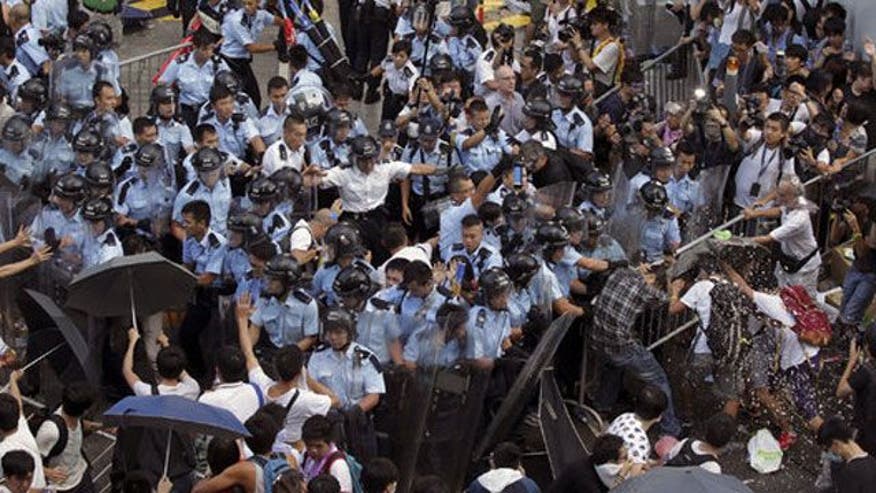
HONG KONG –  Hong Kong’s police on Monday defended their use of tear gas and other tactics to control protests that have paralyzed the city’s financial district, appealing to the thousands gathered to demand more democracy to stop the unprecedented mass act of civil disobedience for the sake of safety and stability.

The employment of tear gas appeared to have backfired, judging from the growing crowds Monday as people finished work and joined weary-looking students camped on major roads near the city’s government headquarters and in several other parts of Hong Kong.

“The students are protecting the right to vote, for Hong Kong’s future. We are not scared, we are not frightened, we just fight for it,” said Carol Chan, a 55-year-old civil service employee who took two days off to join the protests after becoming incensed over police use of tear gas on Sunday.

Instead of candlelight, a few hundred people staged a brief “mobile light” protest on Monday night, raising their mobile phones with their screens glowing into the air. One person chanted the name of the city’s unpopular leader, Chief Executive Leung Chun-ying, while the others responded with “Resign. Resign.”

Signaling it doesn’t expect a quick end to the demonstrations, the government announced it was canceling a fireworks display planned for Oct. 1 National Day celebrations.

In a shift of tactics Monday, uniformed police manned barricades and looked on, preventing access to some buildings, but otherwise not intervening.

Police said they used 87 rounds of tear gas on Sunday in what they said was a necessary but restrained response to protesters’ efforts to push through cordons and barricades. They said 41 people were injured, including 12 police officers.

“Police cordon lines were heavily charged, by some violent protesters. So police had to use the minimum force in order to separate the distance at that moment between the protesters and also the police,” Cheung Tak-keung, the assistant police commissioner for operations, told reporters Monday.

Protesters donned rain capes, surgical masks and goggles, wrapped their heads and glasses in plastic and used umbrellas to shield themselves from the searing clouds of tear gas unleashed by police on Sunday. Each time they fled, but returned in defiance. Late Sunday, riot police withdrew and Hong Kong’s chief executive, Leung Chun-ying, issued a public appeal for everyone to go home and stop blocking traffic.

Across Victoria Harbor, in crowded Kowloon, crowds blocked a major intersection, as young people climbed atop subway station exits and activists rallied the crowds.

The crowds were constantly shifting, as people moved in and out of the sit-ins, some bringing in food and drink while others fetched their own.

“It’s already the fourth day, so it’s really tiring,” said Ching-ching Tse, a 24-year-old student at the Chinese University of Hong Kong. Tse, wearing cotton gloves, said she was on her second day of picking up trash in the protest area with her friends. “So we are forming some groups and hope we can do some shifts and take turns.”

While many Hong Kong residents support the calls for greater democracy — dubbed the “umbrella revolution” by some although the crowds’ demands fall far short of revolution — the unrest worries others.

“I strongly disagree with the protesters,” said an older woman who gave only her surname, Chan. “Those of us who came to the city 60 or 70 years ago had nothing and we worked and suffered so much to make Hong Kong the rich city it is today. And now the protesters have made our society unstable. For me, being able to eat and sleep is already a luxury. I don’t need democracy. What does it mean?”

Many younger Hong Kong residents have much higher expectations. Raised in an era of plenty and with no experience of the political turmoil of past decades in mainland China, they are demanding universal suffrage and protesting Beijing’s decision last month that candidates in the city’s first-ever election for the top leader must be hand-picked by a committee of mostly pro-Beijing tycoons, a move many residents of the former British colony view as reneging on promises to allow greater democracy in the semi-autonomous territory.

China has called the protests illegal and endorsed the Hong Kong government’s efforts to quell the demonstrations, which are undermining the city’s image as a safe financial haven. Beijing has taken a hard line against a variety of threats to the Communist Party’s monopoly on power, including clamping down on dissidents and Muslim Uighur separatists in the country’s far west.

The Hong Kong authorities’ efforts to shut down the protest so far have backfired, said Steve Tsang, a senior fellow at the University of Nottingham’s China Policy Institute.

“People are feeling a kind of guilt that they were allowing the young kids in their late teens and early 20s to take all the risks, so people are coming out to support them. That’s what we are seeing on the ground,” he said.

While Hong Kong was under British rule, its leader was chosen by London in an arrangement that faced virtually no opposition. After China took control from the British in 1997, it agreed to a policy of “one country, two systems” that allowed the city a high degree of control over its own affairs and kept in place liberties unseen on the mainland. It also promised the city’s leader would eventually be chosen through “universal suffrage,” a pledge that Hong Kongers now say Beijing is failing to keep.

The protests began a week ago with a class boycott by university and college students, who said they would stand firm until officials meet their demands for reforming the local legislature and withdrawing the requirement that election candidates be screened.

Leaders of the broader Occupy Central civil disobedience movement joined them early Sunday, saying they wanted to kick-start a long-threatened mass sit-in demanding Hong Kong’s top leader be elected without Beijing’s interference.

Occupy Central issued a statement Monday urging Leung to resign and saying his “non-response to the people’s demands has driven Hong Kong into a crisis of disorder.” It said the protest is now “a spontaneous movement” of all Hong Kong people.


View the original article here


Thousands of pro-democracy protesters in Hong Kong undeterred by tear gas, barricades - VIDEO: Hong Kong protests for democracy