9 September 2013 Last updated at 19:41 ET By Mike Lanchin BBC World Service  Carmen Quintana before (left) and after the attack (right) Forty years ago, Gen Augusto Pinochet seized power in Chile – 17 years of military rule followed, during which thousands of people were tortured or killed. One woman who was doused with kerosene and set on fire, survived to tell the tale.
Carmen Quintana has one lasting image from the day, 27 years ago, when she and another young Chilean student were attacked, and set alight by soldiers during an anti-government protest.
“I just looked down at my blackened hands and at my burning clothes, and I suddenly saw myself in flames,” she says.
It was 2 July 1986, the first of two days of nationwide strikes in Chile against Augusto Pinochet’s rule.
Eighteen-year-old Carmen was a serious young woman with thick bushy hair, from a left-wing family fiercely opposed to the Pinochet regime. From an early age she had gone with her parents on anti-government demonstrations – and had witnessed first-hand the repression meted out by the feared Carabineros, Pinochet’s jackbooted police.
“We believed in what we were doing, and we thought we could bring about change,” she says.
With the organisers of the July 1986 protests promising to make it the biggest opposition show of force in years, Carmen had helped rally support among other students at her university. Word had gone around that Pinochet had ordered thousands of extra soldiers on to the streets as reinforcements.
But as Carmen and her comrades made their way on foot to join the crowds already gathering in the centre of Santiago early that July morning, no-one had reason to believe that the day’s demonstrations would be different from any others.
Speaking to the BBC from her adopted home in Montreal, Canada, where she sought refuge almost three decades ago, Carmen talks slowly, carefully recounting each detail of the events that scarred her mentally and physically.
Now 45 years old and married with three daughters, she is clearly still grappling with the horrors of the past.
Carmen and a small group of students reached the Avenida General Velasquez, one of the main arteries running through central Santiago, just as other protesters were beginning to erect makeshift barricades out of old tyres.
“We ran into some guys who asked us if we wanted to help,” she says. “Sure, we replied, why not.”
Then suddenly an army jeep came around the corner, full of soldiers. Their faces were all painted and they were wearing combat gear.
Tossing the tyres to one side, the youngsters fled in different directions. The soldiers jumped out and gave chase. Only Carmen and another student, 19-year-old Rodrigo Rojas Denegri, were caught. The rest got away.
“They grabbed Rodrigo first and threw him to the ground, kicking him. They put me up against the wall and searched me. I could see Rodrigo lying there, bleeding. They said to me, ‘What were you doing, where were you going?’ I said, ‘Going to the university, to study.’ They swore at me and hit me with the butt of their machine guns. I began to cry.”
Another group of soldiers then appeared, carrying a couple of tyres and a bottle of kerosene. “So this is what you were up to, right?” one of the soldiers said.

Gen Augusto Pinochet (left) just hours after the 11 September 1973 coup
Carmen was still standing against the wall and Rodrigo was still on the ground. Neither of them replied. One of the officers took the bottle of kerosene and began to pour its contents over Carmen, soaking her from top to bottom. He did the same to Rodrigo, dousing him “as if he was watering a plant”, she says.
Carmen pauses. Her voice drops. This is the most painful part of her tale. At that stage, she says slowly, she had still thought that the soldiers were only trying to make fun of them and would soon let them go. She even remembers saying to herself, “I’ll have to go home now and get washed, and I won’t make it to the demos.”
Continue reading the main story

1970 – Salvador Allende becomes world’s first democratically elected Marxist president11 September 1973 – General Augusto Pinochet ousts Allende in coup17 years of military rule follow About 3,000 people were killed or disappearedDec 2006 – Pinochet dies in Santiago aged 91Though accustomed to the regime’s violence, nothing had prepared her for what would happen next.
“All of a sudden one of the soldiers threw something close to us, like a Molotov cocktail. And as it hit the ground it exploded, and Rodrigo and I turned into human torches.” The flames quickly took hold of Carmen’s hair and clothes. She threw herself to the ground, madly trying to put out the fire.
From the corner of her eye, she could see Rodrigo desperately rolling around, doing the same.
Before she lost consciousness, she felt someone throw a blanket over her burning body, and then pick her up and toss her carelessly into the back of a truck.
When Carmen woke up, an hour or so later, she was lying in a ditch, off the main highway. Rodrigo was there too. “I was so frightened I just lay there, pretending to be dead. I didn’t dare move.”
Slowly and painfully, they clambered to their feet and looked each other over. “Half of Rodrigo’s hair was missing, all his face was black and burnt,” she says.
Her own face, arms and hands were black and sore, and already peeling. Their clothes were almost totally shredded.
They hardly spoke a word to each other, Carmen remembers, such was the searing pain from their burns. But when a police patrol arrived, having been notified by some local workers who saw the two youngsters wandering “like zombies” across the road, Rodrigo shot Carmen a warning glance. “Don’t say anything, they’ll do away with us,”‘ he told her.
“I was just so full of anger and pain that all I said to the policemen was, ‘Just shoot me, please, now, so the pain stops,’” Carmen says.
The police took them to hospital. Carmen had second and third degree burns on two-thirds of her body.
She was in a coma for weeks.
Four days after arriving at hospital, Rodrigo died from his injuries.

Fellow student Rodrigo Rojas Denegri was just 19 when he died
His funeral became the focus of further nationwide demonstrations. And such was the scale of the outrage that even the then American ambassador to Chile attended, in spite of his government’s long standing support for Pinochet.
Unrepentant, the Chilean leader went on national television soon after to claim that Carmen and Rodrigo had been responsible for setting themselves on fire, because they had been carrying concealed Molotov cocktails, which had exploded and burnt them. That would continue to be the official version of events.
Carmen spent the first months in hospital in Chile, and was then moved by her family to Canada, where she continued with painful reconstructive treatment on her face and body.
In the first year alone, she had more than 40 separate operations. She gradually recovered the use of both her hands and legs, but lost the hearing in her right ear. She says, almost cheerfully, her face now has “a bit more of my own colour back”, although it is still scarred.
In the years that followed, Carmen travelled through Europe and North America denouncing the Pinochet regime.

In 1991, a year after he was forced to step down as Chile’s president, a military tribunal held a hearing about her case. It cleared one of the officers present that day, Lt Pedro Fernandez Dittus, of responsibility for Rodrigo’s death, and for the attack on Carmen.
It merely found him “negligent” for having failed to seek adequate medical help. In 1993 he was sentenced to 600 days in prison by the Supreme Court.
Carmen, who was later awarded $500,000 (£320,000) in compensation by a Chilean judge, says she still wants her attackers – and their commanders – to face criminal charges in a civilian court.
“I feel that I am the voice of so many other Chileans who died,” she says.
Carmen Quintana was speaking to Witness – which airs weekdays on BBC World Service radio. You can hear Mike Lanchin’s report here.
You can follow the Magazine on Twitter and on Facebook
View the original article here
Burned alive for protesting

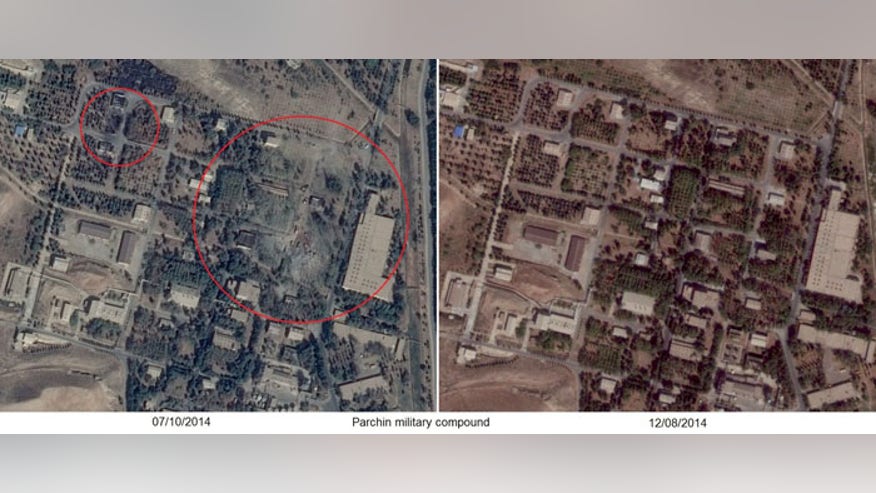 Satellite photos from before and after Sunday’s blast show an explosion that some experts say proves Iran’s nuclear weapons program is real. (IsraelDefense.com)