Showing posts with label Concern. Show all posts

Thursday, January 29, 2015

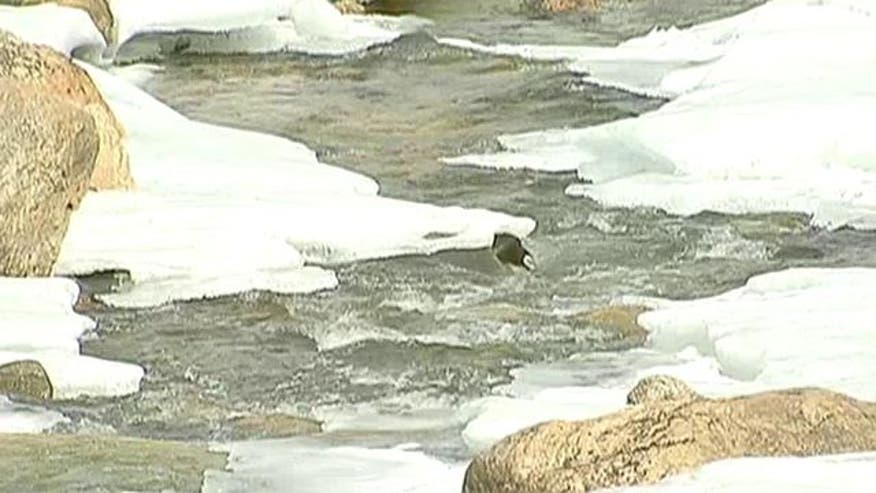
Colorado to California: Hands off our water supply - VIDEO: Concern over decision to keep river water

Colorado is moving to keep tighter control over its own water supply, rankling drought-stricken western states like California.

In the process, Colorado is learning a valuable lesson in interstate diplomacy.

James Eklund, director of the Colorado Water Conservation Board, initially gave some tough remarks in explaining his state’s intentions in an interview with The Associated Press. “If anybody thought we were going to roll over and say, ‘OK, California, you’re in a really bad drought, you get to use the water that we were going to use,’ they’re mistaken,” he said.

Some of Eklund’s fellow water authorities were taken aback. Eklund is in charge of the state’s water policy and planning and as senior deputy legal counsel to Gov. John Hickenlooper, his word carries a lot of weight.

“There was a lot of surprise with that remark,” said Bill Hasencamp, Colorado River Program manager at the Metropolitan Water District in Los Angeles, which serves 19 million people.

Eklund later tried to downplay his comments. “Unfortunately my comment, the quote that was attributed to me, suggested that we were flexing our muscle,” he said. “And that’s just not the case.”

But Colorado is still moving forward on its new water plan.

To understand what’s at stake here, a brief overview of the critical nature of the Colorado River and those who depend on it is in order:

The river provides water to 40 million people in the states of Arizona, Wyoming, New Mexico, Utah, Nevada, California and Colorado. These seven states also make up one of the driest regions in the nation, dependent on a water flow that is miniscule in comparison to rivers in other parts of the United States.

Making matters worse, recent droughts throughout the region have reduced the Colorado’s already limited flow and left massive reservoirs like Lake Mead, which sits in Nevada and just over the Arizona border, at record lows.

Every state gets a predetermined share of the resource, a quantity divided up in 1922 under a federal compact. And while the 1922 Colorado River Compact governs the system, scientists now know the 93-year-old agreement was reached at a time when the region was going through an unusually wet period. States get their allowance regardless of whether they need more or less.

“There’s a long-term deficit beyond just a short-term drought that we have to come to grips with,” Hasencamp said. “There’s just not enough water in the Colorado River to meet the demands that were designed in the 1922 Compact.”

Unlike California, Colorado has had more than it needs. In years past, Colorado has allowed Southern California to dip into its surplus, to help stretch its supply. That is about to change.

Under Eklund, Colorado is drawing up a water plan for the state. The draft, which has been presented to Hickenlooper, calls for Colorado to save for the future. It would keep its legal share of the 1922 Compact allotment, rather than spread the wealth.

“States depend on water that originates here,” Eklund said. “And as a result, everybody watches us. If we twitch on water, everybody notices.”

Douglas Kenney, a western water expert at the University of Colorado Law School, said it’s never been a secret upstream states like Colorado are going to consume more water. “I mean, that’s predictable,” he said. “And states like California have certainly known this is coming. What can they do? Well, they can look to the other sources of supply, they can conserve water, they can look for creative deals … it’s not something that sneaks up on anyone.”

In fact, Southern California has been making plans. According to Hasencamp, it’s invested more than $1 billion over the last decade to reduce its dependence on the Colorado.

Kenney said the issue is bigger than the region itself. “Once you broaden a little further it is a problem with national economic implications, and of course that translates to the global economies.”

More than 16 million people in Arizona, Colorado, Nevada, New Mexico, Southern California, Utah and Wyoming are employed as a result of working directly or indirectly with this water.Researchers at Arizona State University estimate the total economic impact of the Colorado River is $1.4 trillion.

“The seven states have to work together,” Hasencamp said.

Eklund said he was not trying to send a tough message to other states. “The state of Colorado is working … to make sure that we have collaborative approaches to the situation on the Colorado River, which is in the midst of the worst 15 years of drought that we’ve ever measured.”

In his State of the State address, Hickenlooper pointed out, “Even when our snow pack is substantial and the state has what looks like a water surplus, a drought always looms. Water in Colorado is always in finite supply.”

Hickenlooper went on to say the new water plan “goes a long way to ensure we strategically allocate this precious resource to maximize our entire state’s ability to grow and flourish.”

Hasencamp said downstream states are making hard choices and doing what they can to lessen demand on the scarce resource. “We know that we can’t have one state fight against another,” Hasencamp said. “We all have to work together.”

Alicia Acuna joined Fox News Channel (FNC) in 1997 and currently serves as a general assignment reporter based in the network’s Denver bureau.


View the original article here


Colorado to California: Hands off our water supply - VIDEO: Concern over decision to keep river water

Sunday, September 14, 2014

Senior UN official voices concern over ‘political stalemate’ in Haiti

un-official-Haiti-740 Special Representative for Haiti Sandra Honoré briefs the Security Council (UN Photo)

NEW YORK, United States, Friday September 12, 2014, CMC - Amid continuing mistrust and disagreement over the electoral process in Haiti, a senior United Nations official has voiced deep concern over the political stalemate in the French-speaking Caribbean Community (CARICOM) country.

Briefing the Security Council on Thursday, Trinidadian Sandra Honoré, head of the UN Stabilization Mission in Haiti (MINUSTAH) said that a key provision of the recently-agreed El Rancho Accord, implied the formation of a new government, changes in the composition of the electoral council, and a new Legislature installed, have not been implemented due to political deadlock.

She said the timely establishment of the electoral body was hampered by “a group of politicians opposed to the El Rancho Accord who consistently blocked the required quorum”.

Stressing that no agreement had been reached on the required framework for the elections to be held, Honoré expressed particular concern that inability to carry out the polls before the end of the year that may result in “creating an institutional vacuum” after the current Parliament will be rendered dysfunctional on January 12.

In this context, she called for an immediate solution to be found on the basis of the rule of law, hailing the recent signs of willingness of the political parties to renew an inclusive dialogue, and President Michel Martelly’s intention to engage in discussion with opposition groups and civil society.

“While I welcome these various attempts at identifying a consensual solution, through dialogue, as soon as possible, I also wish to call on all actors concerned to ensure that the solution be on the basis of the Constitution and within a solid legal framework that allows for credible, inclusive, and transparent elections in support of a peaceful democratic transition in 2015,” she told the Council.

Honoré said the overall security environment, including the five Departments vacated by MINUSTAH’s military component, has remained relatively stable, adding that only one-fifth of demonstrations are politically-motivated, while the causes of most of them are rooted in socio-economic problems, such as lack of access to education, electricity and water.

Underlining the critical importance of guaranteeing the security and, in line with the implementation of the Haitian National Police (HNP) Development Plan 2012-2016, she called for improvements in the operational capacity of the national police force.

“Structural and technical challenges such as a weak administrative and internal oversight capacity, limited regional coverage and scarce institutional capacity in specialized fields, including prison management remain, and require a redoubling of efforts by both the Haitian Government and its international partners,” she said.

As for the humanitarian situation, Honoré praised the Haitian government and its international partners for their efforts in implementing the national cholera elimination plan that has led to the significant reduction of the toll of the epidemic.

She also welcomed government’s initiatives in economic sphere aimed at attracting investors, stimulating economic growth and creating more jobs.

Honoré also noted that amid challenges facing Haiti in the field of democratic consolidation and the rule of law, the reconfiguration of MINUSTAH’s military component as two battalions, recommended by UN Secretary-General Ban Ki-moon, would ensure “an adequate stabilization presence to support Haitian institutions, particularly in the context of the next electoral cycle and the continuing development of the Haitian National Police”.

The envoy also underscored the essential role of the comprehensive reforms of the justice sector for the positive development of the country.

“Without a well-functioning justice system, including corrections, even the best trained and equipped police force will be unable to perform its duties to provide a safe and secure environment, enforce the law, and, ultimately, protect the rights of Haitian citizens,” she said.

Honoré reiterated her call for the State institutions and public life actors to continue fulfilling their obligations and to assume greater leadership in order to maintain gains in peace, security and stability through the consolidation of the democratic process, the rule of law and good governance.

She also underlined that these goals demanded international cooperation, including additional financial aid from global partners.

“We will work with the Government, the UN country team and Haiti’s international partners to develop a comprehensive transition plan that underpins the gradual reduction of the Mission’s footprint,” she said.

Click here to receive free news bulletins via email from Caribbean360. (View sample)


View the original article here


Senior UN official voices concern over ‘political stalemate’ in Haiti

Friday, August 1, 2014

Fires under control in St. Andrew hills as air quality becomes a concern

There’s concern this morning about the environmental impact of  the bush fires which have razed large acreages of  farmland and other hilly sections of Jacks Hill in St. Andrew over the past 24 hours. One environmentalist is warning that there will be implications for air quality in the Corporate Area.

Chief  Executive Officer of  the Jamaica Environment Trust, Diana McCauley, says the fires in a wide section of  the hills overlooking Kingston have made a bad situation worse:    There were several anxious moments last night for residents of  Jacks Hill and surrounding areas in St. Andrew as massive bush fires spread uncomfortably close to houses and other properties.

A house in an informal settlement near Tavistock was destroyed. The fire is believed to have started at that location. Fire personnel along with Jamaica Defence Force helicopters transporting water battled the fires in other communities including Ivor, Cassia Ridge and Westphalia.

Three units responded to the fires which started about 10 o’clock in the morning and later spread due to heavy winds.

And up to early this morning some of  the fires were still burning along Jacks Hill Road and in Cassia Ridge. Fire personnel said others had been extinguished.


View the original article here


Fires under control in St. Andrew hills as air quality becomes a concern

Wednesday, July 9, 2014

Barbados voices concern over impact of climate change in the Caribbean

Hurricane-Soufriere-740 Mudslide clean up from Hurricane Tomas in Soufriere, St. Lucia.

BRIDGETOWN, Barbados, Tuesday July 8, 2014, CMC – Prime Minister Freundel Stuart says Caribbean countries and other small island developing states (SIDS) are becoming increasingly susceptible to climate change and steps have to be taken to reduce this vulnerability.

Stuart noted that as a result of climate change, unprecedented flooding was taking place in several parts of the world, including the Caribbean, with neighbouring territories experiencing unseasonal hurricane type behaviour.

“St. Vincent and the Grenadines, for example, around Christmas last year and St. Lucia and Dominica experienced systems that were unprecedented for that time of the year. Seventeen per cent of the gross domestic product of St. Vincent and the Grenadines was destroyed by that system last December.

“We were fortunately spared (that system but) about two or three years before, (Hurricane) Tomas passed by at a very awkward time for us as well and I am not aware that we have fully come out of the damage done by Tomas,” he said.

Click here to receive free news bulletins via email from Caribbean360. (View sample)

Prime Minister Stuart said that Barbados would be articulating its position on the effects of climate change on SIDS at the Third International Conference on Small Island Developing States, which will be held in Samoa in September.

“We’ll be accentuating a lot of those issues that have to do with the threats posed to small island developing states by climate change and making sure that we can access a lot of the funding that is being put in place to effect adaptation and mitigation measures so that we can minimise our risks.

“So, for us, this is not an academic issue. This is an issue that affects people in their everyday lives, and therefore, we have to continue our leadership on the issue of the environment and on issues related to climate change as these two affect small island developing states, of which Barbados is one,” he said.

The United Nations Conference on Small Island Developing States will be held in Apia, Samoa, from September 1 to 4.

Barbados and other CARICOM countries will be hoping to develop and secure partnerships in areas such as climate change and disaster risk management, oceans and biodiversity, water and sanitation, food security and waste management, sustainable economic development, sustainable energy and social development, health and non-communicable diseases, and youth and women.


View the original article here


Barbados voices concern over impact of climate change in the Caribbean

Friday, September 13, 2013

Claims of concern

CHIEF Technical Director in the Labour and Social Security Ministry Errol Miller says the entity will be looking into allegations of Jamaican migrant workers harassing women in the town of Leamington in Ontario, Canada, made in a media report on Monday.

While it also fingers seasonal workers from other countries, the National Post report makes specific mention of Jamaican workers.When contacted yesterday, Miller told the Jamaica Observer that he was unaware of the claims.“The report you indicated is a report I am hearing for the first time and it is a report that we would have to investigate first of all, to ensure the authenticity and, also, to see what we could put in place to obviate those claims,” he told the Observer.“They (claims) are ones of concern and it is something that we will definitely look into,” he added, noting that the investigations would involve speaking to the ministry’s own liaison officers in Canada.“That’s the first place we would have to start to ensure that the claims are, in fact, true,” Miller said.The Observer was told that Labour Minister Derrick Kellier as well as Permanent Secretary Alvin McIntosh were off the island.According to the article, Jamaicans and other nationals from the eastern Caribbean make up 20 per cent of five to six thousand migrant workers who arrive in Leamington to help the area live up to its reputation as the “tomato and greenhouse capital of Canada”.It said the lion’s share of the workers come from Mexico, while there are also Filipino, Mexican Mennonite, and nationals from various parts of Asia in the mix.“And every year, according to Leamington Mayor John Paterson, local women in the rural lakeside town of about 28,000 have complained of sexual harassment on the part of the seasonal labourers — unwelcome sexual invitations, persistent queries about relationship status, comments about physical appearance. Some women even reported workers grabbing their genitals and making lewd gestures at them,” the National Post reported.The report said the harassment has led women to avoid downtown and certain stores, particularly on weekends, “when the workers are more likely to be cashing their cheques, doing laundry and shopping for groceries”.According to the report, there were more complaints than usual this year, which led Paterson “to ask the police services board in late August how to address sexual comments and aggressive tendencies” of some migrant workers employed in Leamington.Paterson is reported as saying that he had worked quietly with the previous Jamaican liaison officer for temporary foreign workers to address the issue, “but nothing changed”.Meanwhile, the report stated that Vernon Melhado, deputy chief liaison officer with the Jamaican liaison office in Leamington, did not return calls to the National Post, “but told the Windsor Star his office had not received one complaint about sexually aggressive behaviour”.Meanwhile, it said Jamaica’s chief liaison officer for Foreign Agricultural Management Services, Larkland W Stone, did not offer a comment on the matter.

HOUSE RULES


1. We welcome reader comments on the top stories of the day. Some comments may be republished on the website or in the newspaper – email addresses will not be published.


2. Please understand that comments are moderated and it is not always possible to publish all that have been submitted. We will, however, try to publish comments that are representative of all received.


3. We ask that comments are civil and free of libellous or hateful material. Also please stick to the topic under discussion.


4. Please do not write in block capitals since this makes your comment hard to read.


5. Please don’t use the comments to advertise. However, our advertising department can be more than accommodating if emailed:mailto:advertising@jamaicaobserver.com.


6. If readers wish to report offensive comments, suggest a correction or share a story then please email: community@jamaicaobserver.com.


7. Lastly, read our Terms and Conditions and Privacy Policy

comments powered by

View the original article here


Claims of concern